For decades the debate has been framed as a competition: 3D printing versus CNC machining, addition versus subtraction, layer-by-layer versus chip-by-chip. The industries that move the most material, including aerospace, energy, and medical, have largely settled that debate by combining both. Hybrid manufacturing means using additive and subtractive processes together, sometimes inside a single machine, to produce parts that neither process could make on its own. This guide covers what hybrid manufacturing actually is, how it compares to pure additive and pure subtractive workflows, the verticals where it has gained the strongest foothold, and where STYLECNC mold-milling capability fits in. For the underlying 3D printing versus CNC carving primer, see the 3D printer vs 3D CNC router comparison.
What Is Hybrid Manufacturing?
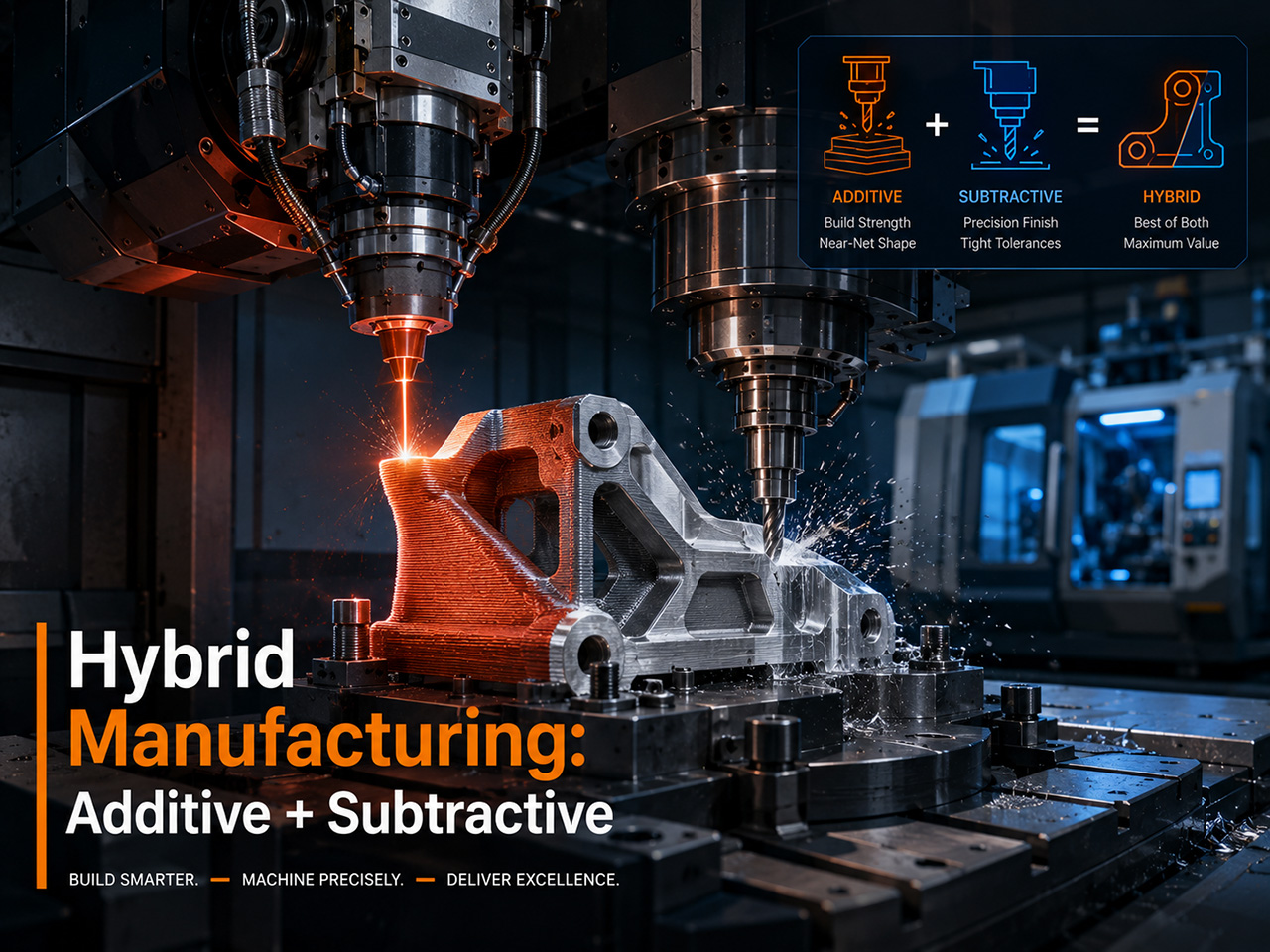
Hybrid manufacturing combines additive (3D printing or metal deposition) and subtractive (CNC machining) processes into a single workflow or single machine. The additive step builds near-net-shape geometry from metal powder or wire, and the subtractive step finishes critical surfaces, internal features, and tight-tolerance dimensions in the same setup.
Hybrid manufacturing exists in 2 main forms. The 1st is the single-machine hybrid, where additive deposition heads and CNC milling spindles share the same enclosure, the same axes, and the same work envelope. DMG MORI Lasertec 65 3D, Mazak Integrex i-400AM, and Okuma LASER EX are the most-cited examples. The 2nd is the workflow hybrid, where a 3D printer builds the part and a separate CNC machine finishes it, with both processes managed as a continuous pipeline. Both forms qualify as hybrid manufacturing in industry literature.
The distinguishing feature is intent. A shop running a 3D printer in one corner and a mill in another is not necessarily doing hybrid manufacturing. A shop that designs parts knowing some features will be printed near-net-shape and others will be machined to tolerance is doing hybrid manufacturing, regardless of whether the 2 processes share a single machine.
Additive vs Subtractive vs Hybrid: The Definitive Comparison
The table below compares the 3 approaches across the factors that drive process selection in production environments. The comparison is built as a featured-snippet target for buyers researching their options.
| Faktor | Additive (3D Printing) | Subtraktiv (CNC) | Hybrid |
|---|---|---|---|
| Build approach | Layer-by-layer deposition of metal or polymer | Material removal from a solid stock block | Near-net-shape deposition plus finish machining |
| Geometrisk frihet | Highest, including internal lattices and channels | Limited by tool access and stock geometry | Combines deposition freedom with machined precision |
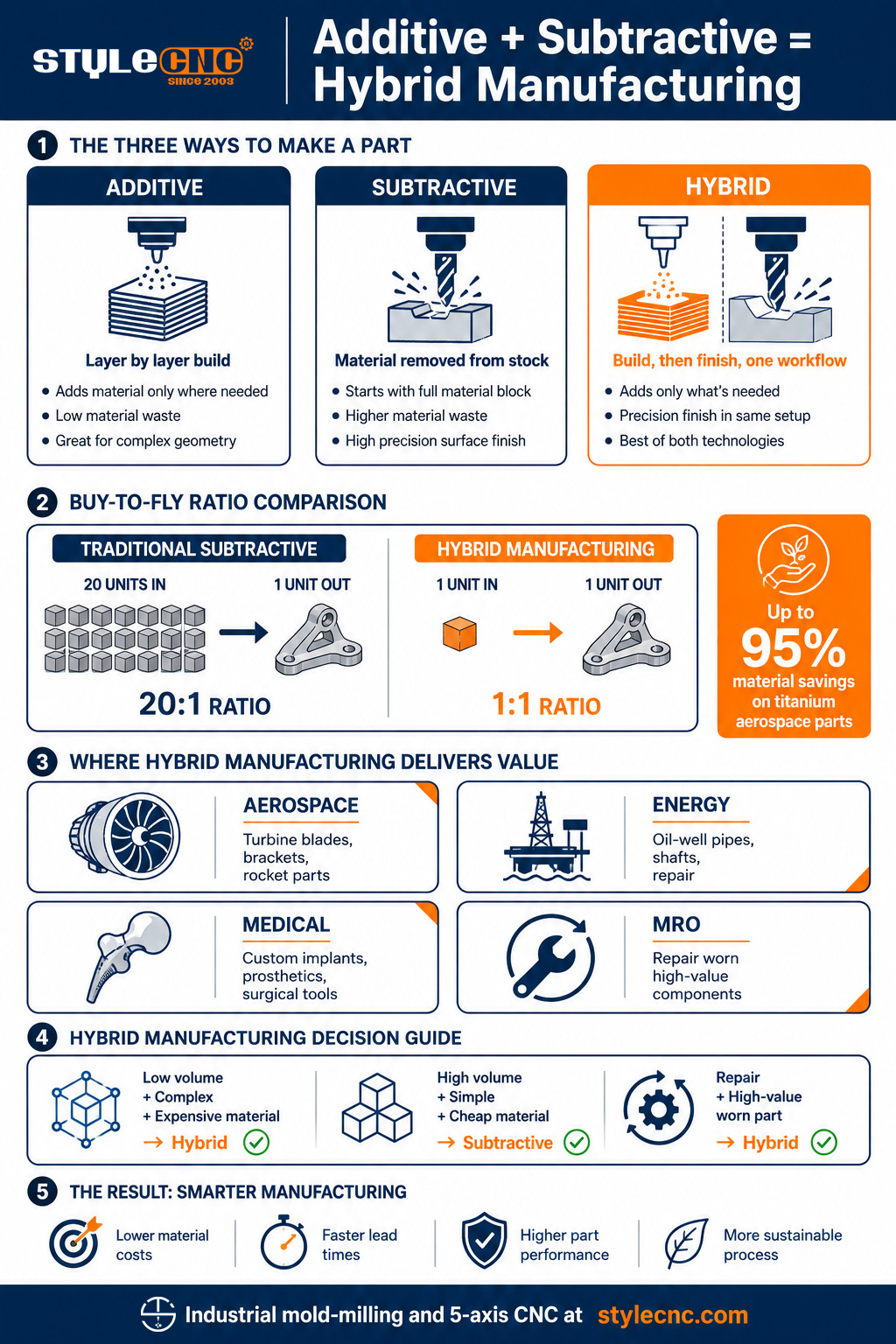
| Material waste (buy-to-fly) | Close to 1:1 for most parts | Up to 20:1 for complex aerospace parts | Approaches 1:1 even on aerospace alloys |
| Ytbehandling | Post-processing usually required | Ra 1.6 to 3.2 directly off the machine | Machined finish on critical surfaces |
| Production volume sweet spot | 1 to 50 parts per design | 100+ parts where tooling amortizes | Low volume, complex, high-value parts |
| Verktygskostnad | Ingen | High upfront for fixtures and tools | Moderate, fixtures still required |
| Cykeltid per del | 5 to 15 hours typical for metal | 30 to 90 minutes typical for metal | Faster than pure additive on finished parts |
| Kapitalinvesteringar | 10K to 1M $depending on technology | 30K to 500K $for industrial CNC | 1M to 2M $for single-machine hybrid systems |
| Bästa passform | Prototypes, complex geometry, custom medical | Production runs, tight tolerances, hard metals | Aerospace, energy, MRO, mold conformal cooling |
The most striking difference is the buy-to-fly ratio. Traditional subtractive machining of titanium aerospace brackets often removes 95 percent of the starting stock as chips, leading to ratios as high as 20:1. Hybrid manufacturing builds near-net-shape forms first, then machines only critical surfaces, driving the ratio close to 1:1. On nickel superalloys and titanium that cost hundreds of dollars per kilogram, this material savings alone justifies the capital investment for many aerospace and energy producers.
How Hybrid Manufacturing Works
Hybrid manufacturing combines 3 core technologies: a deposition system, a CNC machining system, and integrated CAD/CAM software that programs both processes against the same part model.
Directed Energy Deposition Plus 5-Axis Milling
The dominant industrial pattern is directed energy deposition (DED) combined with 5-axis milling. A laser or electron beam melts metal powder or wire as it is fed through a coaxial nozzle, building near-net-shape features layer by layer. The same machine then changes from the deposition head to a milling spindle and finishes critical surfaces to tolerance. DMG MORI Lasertec 65 3D and Mazak Integrex i-400AM are reference implementations. According to industry coverage, the Lasertec 65 3D handles parts up to 500 mm in diameter and combines 5-axis material deposition with full 5-axis milling in a single enclosure.
Powder Bed Fusion Plus Subtractive Finishing
A 2nd pattern uses powder bed fusion (PBF) to print the part in one machine, then transfers it to a CNC-fräs for finishing. This workflow is more common in small-shop adoption because it avoids the capital cost of an integrated machine. The trade-off is part handling and re-fixturing between processes. Matsuura Lumex and Sodick OPM platforms compress this workflow into a single machine for smaller, more intricate parts.
Wire Arc Additive Plus CNC Milling
Wire arc additive manufacturing (WAAM) uses a welding-style head to deposit material at much higher rates than powder-based methods, often combined with 5-axis milling for finishing. Mazak Variaxis j-600AM uses this approach. WAAM is favored for large structures in aerospace and energy where deposition speed matters more than fine resolution. Each pattern shares the same fundamental design philosophy: build near-net-shape efficiently, then machine for precision.
Choosing between the 3 patterns comes down to part size, material, and accuracy requirements. DED with 5-axis milling dominates aerospace and large energy components where part diameter exceeds 200 mm and titanium or nickel superalloys are involved. PBF with subtractive finishing handles smaller intricate parts under 200 mm where surface detail matters more than build rate. WAAM with CNC milling owns the very large structural work where deposition speed is the gating factor and surface finish requirements are moderate. Most production-grade hybrid shops eventually deploy more than one of these patterns, matching the process to the part rather than forcing every part through the same machine.
Industry Applications: Aerospace, Energy, Medical, and MRO
Hybrid manufacturing has gained its strongest foothold in 4 verticals, each with specific economic or technical drivers.
Aerospace
Aerospace was the 1st industry to adopt hybrid manufacturing at scale. Engine brackets, turbine blades, structural fittings, and rocket engine components are typical applications, particularly in titanium and nickel superalloys. Manufacturing Technology Centre research has documented production cost reductions in the range of 23 to 47 percent on complex aerospace components versus traditional subtractive methods. The DMG MORI Lasertec 6600 DED hybrid is positioned specifically for large workpieces including rocket engine parts.
Energi
Energy producers use hybrid manufacturing for oil-well pipes, turbine blades, valve bodies, and large shafts where wear-resistant features can be deposited on lower-cost base material and then machined. Pipeline and downhole tooling repair has become a major use case: worn high-value components have new material added by DED and are then machined back to original specifications. The economics are compelling when a replacement part costs 50,000 $or more and the repair via hybrid costs a fraction of that amount.
Sjukvård
Medical manufacturing applies hybrid workflows to patient-specific implants, surgical instruments, and dental prosthetics. Titanium hip and knee implants benefit from porous additive structures that promote bone integration, paired with machined contact surfaces ground to mirror finish. Hybrid manufacturing also supports rapid customization in cranial and maxillofacial work where each patient case is unique and traditional manufacturing economics break down.
Underhåll, reparation och översyn (MRO)
MRO is the fastest-growing hybrid application because it solves a long-standing repair economics problem. Worn jet engine blades, gearbox housings, mold cavities, and pump components can be restored by depositing new material onto damaged areas and then machining the repaired surface back to original tolerances. The Mazak Variaxis j-600AM is positioned for this work, combining wire arc additive with 5-axis subtractive in a single setup, particularly for aerospace parts, molds, dies, and oil-drilling components.
A pattern across all 4 verticals is that hybrid manufacturing succeeds where part value is high and traditional approaches break down. Aerospace and energy have the highest material costs, medical has the most customization demands, and MRO has the most expensive part-replacement alternatives. Industries that do not share these characteristics, including general consumer products, commodity automotive parts, and high-volume aluminum fabrication, have not adopted hybrid at the same pace. The economics simply do not favor it when material is cheap, volumes are high, and parts are interchangeable.
Decision Matrix: When Hybrid Manufacturing Makes Sense
Use the matrix below as a starting framework when evaluating whether a given part or production scenario justifies hybrid manufacturing versus pure additive or pure subtractive approaches.
| Produktionsscenario | Rekommenderat tillvägagångssätt | Bakgrund |
|---|---|---|
| Low volume, complex geometry, expensive material | Hybrid | Buy-to-fly approaches 1:1 with deposition; critical features machined to tolerance |
| High volume, simple geometry, common material | Subtraktivt | CNC cycle times of 30 to 90 minutes beat additive 5 to 15 hours per part |
| Prototype, complex internal channels, polymer | tillsatser | 3D printing handles lattices and conformal channels impossible to mill |
| Repair of worn high-value component | Hybrid | Deposition restores material; machining brings it back to original tolerance |
| Custom medical implant, titanium | Hybrid | Patient-specific geometry from additive; finished surfaces from machining |
| Mold cavity with conformal cooling channels | Hybrid | Cooling channels printed inside; tool steel face machined to mirror finish |
| Production run of 500+ aluminum parts | Subtraktivt | Tooling and cycle costs amortize; hybrid capital cost not justified |
| Single-batch jigs and fixtures | tillsatser | 3D printed soft jaws and fixtures cost a fraction of machined equivalents |
The matrix is a starting framework, not a final answer. Individual part economics depend on machine availability, programmer expertise, material costs at the time of purchase, and customer-specific quality requirements. The pattern that holds across scenarios is that hybrid wins when material is expensive, geometry is complex, and volume is low to medium.
Mold and Die Manufacturing: Where Hybrid Meets STYLECNC Capability
Mold and die manufacturing sits at the intersection of every hybrid manufacturing driver. Mold cavities are geometrically complex, the materials are expensive tool steels, the volumes are low (one to a few molds per design), and the customers demand surface finishes that only machining can deliver. Conformal cooling channels, which weave through a mold to control thermal behavior during injection, are a textbook hybrid application: impossible to drill conventionally, easy to print additively, and finishable only by precision milling.
STYLECNC industrial mold-milling capability is built around the subtractive half of this equation. The CNC-formtillverkningsmaskin kategori includes fully automatic mold milling machines for hardened tool steel, aluminum mold tooling, and large multi-cavity production molds. For shops already producing molds traditionally and exploring hybrid workflows, the STYLECNC full automatic CNC milling machine for mold making handles the finishing pass on near-net-shape mold cavities produced by external additive systems.
Ocuco-landskapet 5-axlig CNC-maskinkategori extends this capability for the multi-axis surface work that hybrid mold finishing requires, particularly on conformal cooling tool faces and complex cavity geometry. STYLECNC CNC moulding machines with automatic tool changers complete the picture for production environments where multiple tools and operations sequence through a single setup, reducing the handling that traditionally separates additive and subtractive process steps.
For aerospace, energy, medical, and MRO shops scaling from pure subtractive into hybrid workflows, the practical entry point is upgrading the subtractive side first. Capable 5-axis machining centers with automatic tool changers and verified post-processors integrate cleanly with additive systems from third-party vendors, allowing a shop to test hybrid workflows without committing 1 to 2 million $to a single-machine integrated system on day one.
The staged adoption path typically runs through 3 phases. Phase one introduces 3D-printed jigs, fixtures, and soft jaws alongside conventional CNC mold milling, capturing the time and cost savings on tooling without changing the part-making process. Phase 2 adds a standalone metal additive system for prototypes and low-volume parts, with the existing CNC-maskiner handling finishing operations through manual transfer. Phase 3 either commits to an integrated single-machine hybrid system or formalizes the 2-machine workflow into a production pipeline with shared programming, scheduling, and quality control. Each phase has measurable returns, and shops that follow this path tend to make better hybrid investment decisions than shops that buy a single-machine hybrid system before they understand which parts actually need it.
Glossary: Hybrid Manufacturing Terms
Use this reference when comparing hybrid machines, talking with vendors, or reviewing industry technical documentation.
| Termin | Definition |
|---|---|
| Hybridtillverkning | Production approach combining additive and subtractive processes, in a single machine or a continuous workflow. |
| Riktad energideponering (DED) | Additive process that melts metal powder or wire with a laser, electron beam, or arc as it is deposited. |
| Pulverbäddsfusion (PBF) | Additive process that selectively melts layers of metal powder using a laser or electron beam. |
| Wire arc additive manufacturing (WAAM) | Additive process using a welding-style head to deposit metal wire at high rates, favored for large structures. |
| Near-net-shape | Part geometry close to the final form but requiring finish machining for critical surfaces and tolerances. |
| Köp-till-fly-kvot | Ratio of raw material purchased to material in the finished part. Lower is better; hybrid approaches 1:1. |
| Konformell kylning | Mold cooling channels that follow the cavity contour, typically created by additive deposition and machined for sealing. |
| Beklädnadshuvud | Additive deposition nozzle that delivers metal powder coaxially with a laser beam for material buildup. |
| Kontroll med sluten slinga | Real-time monitoring and adjustment of deposition parameters during the additive build for quality consistency. |
| Multi-tasking machine | CNC platform that combines turning, milling, drilling, and often additive operations in a single setup. |
Vanliga frågor om partihandel med mat och dryck
Will hybrid manufacturing replace traditional CNC machining?
No. Discussions on the Practical Machinist "Additive manufacturing's impact on subtractive manufacturing" thread reflect the broader industry consensus: hybrid does not replace subtractive machining for high-volume production of common materials. It complements subtractive by handling parts that pure machining cannot make economically, including complex geometries, expensive alloys, and repair of high-value components. Most production shops will continue to run dedicated CNC machines alongside any hybrid capability they add.
How much does a hybrid manufacturing machine cost?
Single-machine hybrid systems like the DMG MORI Lasertec 65 3D and Mazak Integrex i-400AM are reported at 1 to 2 million $per machine in industry coverage from VoxelMatters and Modern Machine Shop. Workflow hybrid setups, where a separate additive system feeds a separate CNC machine, are significantly cheaper to build incrementally but require careful process planning to manage part handoff between machines.
What materials work best for hybrid manufacturing?
Titanium, nickel superalloys (Inconel 625 and 718), tool steels (H13, P20), and stainless steels are the most documented in hybrid manufacturing literature. The economics favor expensive materials because the buy-to-fly improvement from near-net-shape additive deposition is most valuable when each kilogram costs hundreds of dollars. Aluminum hybrid work is less common because aluminum is cheap enough that conventional machining remains economical.
Can hybrid manufacturing repair worn parts?
Yes, and MRO is a of the fastest-growing hybrid use cases. Industry coverage from SME and Modern Machine Shop documents Mazak Variaxis platforms used to deposit new material onto worn jet engine blades, mold cavities, and oil-drilling components, then machine the repaired surface back to original tolerances. The economics work because the cost of repair via hybrid is typically a fraction of replacing the original part.
What software do I need for hybrid manufacturing?
CAD/CAM platforms that handle both additive and subtractive programming in the same model are required. Siemens NX Hybrid CAD/CAM, Autodesk PowerMill with additive modules, and proprietary software from machine builders like DMG MORI CELOS dominate the market. Programming hybrid machines requires expertise in both additive deposition parameters and traditional CAM, which is a of the main workforce challenges flagged in industry adoption studies.
Is hybrid manufacturing worth it for a job shop?
It depends on the work mix. Industry sources including SME and additive manufacturing trade publications suggest hybrid pays back fastest in shops doing aerospace, energy, medical, or MRO work on expensive materials in low to medium volumes. Shops focused on high-volume production of common metals like aluminum and mild steel rarely justify the capital cost. A common entry strategy is to use 3D-printed fixtures and soft jaws alongside conventional Cnc before investing in integrated hybrid hardware.